

Construction Site Security: Protecting Equipment and Material Overnight
A construction site is one of the easiest places in India to steal from. It is open by design, spread across a large area, full of valuable material sitting in the open, and almost completely empty from the moment the last shift leaves until work starts again the next morning. Steel, cement, copper wiring, diesel, power tools, and machinery batteries disappear from sites every night — and on many projects, the loss is only noticed when a crew arrives to find material missing and work stalled. This guide covers why construction sites are such easy targets after dark, why the usual night watchman setup does not hold, and what actually protects your equipment and material overnight.
Why Construction Sites Are Easy Targets at Night
Most commercial premises at least have walls, shutters, and locks. A construction site has almost none of that. Boundaries are temporary — sheet fencing, barricades, sometimes just a gate and an open side. Material is stacked in the open because it has to be close to where it will be used. The layout changes week to week as the structure goes up, so blind spots appear and disappear constantly.
And the people who steal from sites often know them well. Labour contractors, drivers, scrap dealers, and anyone who has worked nearby understands exactly what is stored where, when the site empties, and how thin the night cover is. Theft from construction sites is rarely random. It is usually planned around the hours when nobody is watching.
The real cost is not just the material:
When a stack of TMT bars or a coil of copper cable disappears overnight, you pay for it twice. Once to replace it, and again in lost time — a crew standing idle, a pour delayed, a schedule pushed back while replacement material is ordered and delivered. On a project with tight timelines and penalty clauses, a single night’s theft can cost far more in delay than the stolen material was ever worth.
What Actually Gets Stolen from Sites
Site theft follows clear patterns. Thieves go for what is valuable, easy to move, and easy to resell — which on a construction site is a long list.
- Steel and TMT bars — heavy, but high value and easy to sell as scrap.
- Copper wiring and cable — compact, valuable, and almost impossible to trace once stripped.
- Cement bags — taken in small quantities over many nights, often unnoticed until stock counts don’t match.
- Diesel — drained from generators, excavators, and parked machinery.
- Power tools and small equipment — drills, cutters, welding machines, and mixers left in temporary stores.
- Batteries and parts from machinery — removed from JCBs, cranes, and transit mixers parked overnight.
- Scaffolding and shuttering material — easy to load, easy to resell.
Almost all of this happens between late evening and early morning — the hours when the site is dark, the crew has gone, and at most one or two people are left on the premises.
Why the Night Watchman Setup Doesn’t Hold
The standard answer on most Indian sites is a night watchman, sometimes two. It is better than nothing, but it has the same weaknesses on a construction site that it has everywhere else — only worse, because the area is larger and the boundaries are weaker.
One watchman cannot cover a site that spreads across several acres, multiple material yards, and an incomplete structure with dozens of access points. While he is at the main gate, the back fence is unwatched. While he is doing a round, the gate is open. By the small hours, fatigue sets in — and that is exactly when theft happens. Watchmen on remote sites can also be pressured, threatened, or simply outnumbered by a group that arrives with a vehicle. We wrote about why a single guard watching CCTV screens isn’t real monitoring in this guide, and every point applies even more on an open site.
Many sites also have CCTV cameras, installed for progress records or because the client asked for them. But on most projects, those cameras only record. Nobody is watching them overnight. When material goes missing, someone scrolls back through the footage the next day and watches it happen — after the steel is already sold.
What Night-Time Monitoring Changes on a Site
Professional night monitoring turns the cameras your site already has into active protection. Instead of footage sitting on a recorder in the site office until someone checks it, trained operators watch your site through the night, and their only job is to catch something before it becomes a loss.
At Modernext, technology does the tireless first pass across every camera so nothing gets buried in hours of empty footage, and a trained operator focuses on what looks wrong. A stray dog crossing the material yard at 1 AM doesn’t take up anyone’s time. A vehicle stopping beside the steel stack with its lights off does. The operator confirms it is not an authorised delivery or your own staff, and a response goes out immediately — while the people are still on site, not after they have left with the material. Every verified incident is documented and reported through the Modernext app, so the site engineer or project manager has a clear record each morning.
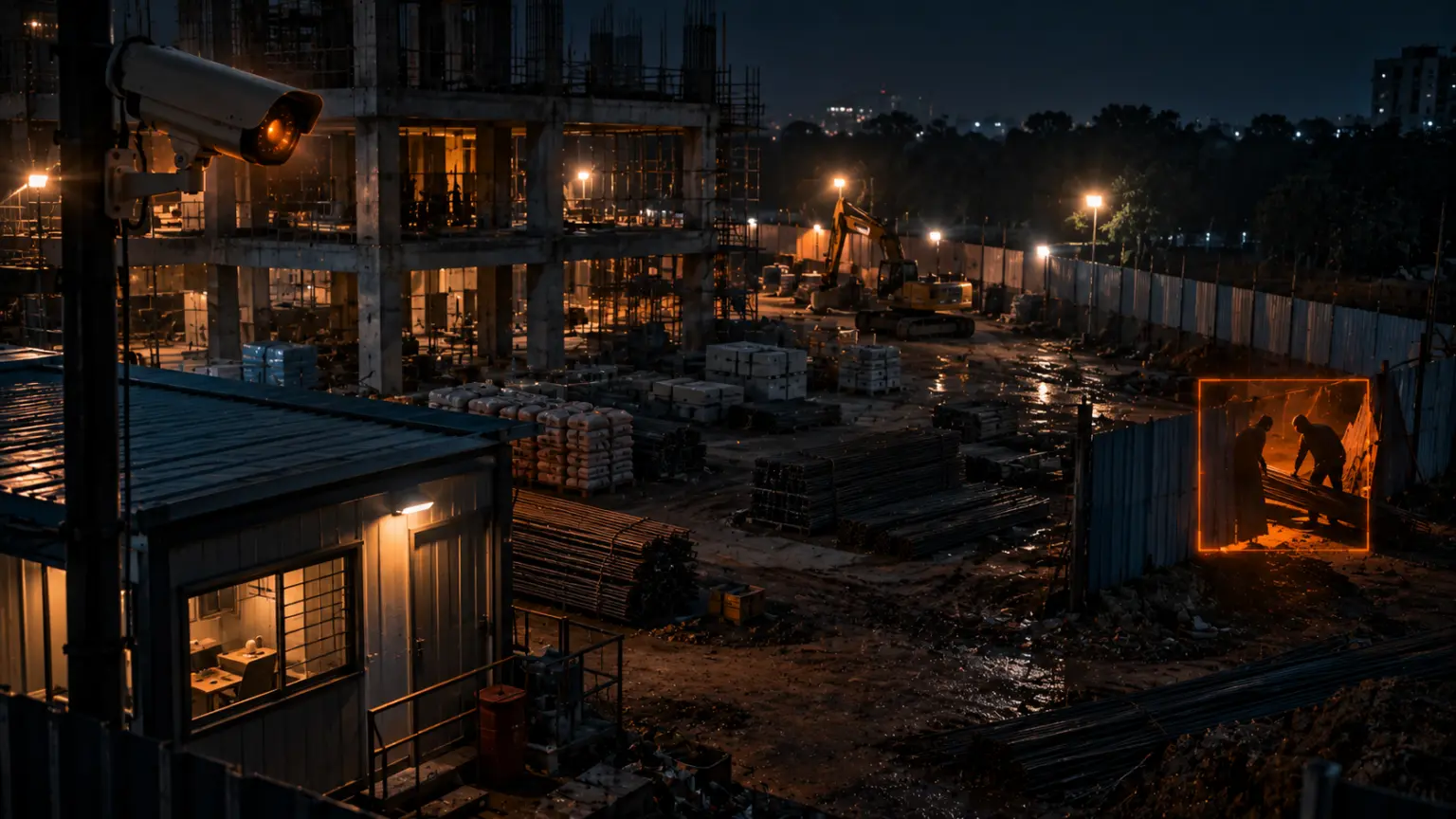
A real night on a site, end to end: It is 2:15 AM on a residential project on the edge of the city. The watchman is at the main gate, at the far end of the site. A small tempo pulls up along the back boundary, where the sheet fencing has a gap, and two men start passing TMT bars over the fence. On a record-only setup, this would show up the next morning as a short stock count and a delayed slab. Instead, the moment is caught on camera within seconds. An operator confirms it is not a scheduled delivery, and a response goes out immediately while the men are still loading. The incident is documented in the Modernext app with time-stamped footage, so the project manager has a clear record to act on by morning. The steel stays on site, and the pour goes ahead as planned.
Works With the Cameras Your Site Already Has
Most mid-size and large projects already run CCTV cameras connected to a DVR or NVR in the site office. Modernext works with that existing setup. A single small device is added near the recorder, using the network connection and power that are already there in the site office. There is no extra cabling across the site and no replacing of cameras that are already working.
Running More Than One Project?
Builders and contractors rarely run just one site. With three or four projects going at once, the weakest site — the remote one, the one with the gap in the fence, the one nobody visits at night — becomes the obvious target. A single monitoring layer can cover every active site the same way, so security doesn’t depend on which project happens to have the more alert watchman. We cover this in more detail in our guide to managing security across multiple locations.
A Night Security Checklist for Site Managers
- Are your material yards in clear camera view — steel, cement, cable, and the tool store?
- Is the full boundary covered, including the back and sides where fencing is weakest?
- Are parked machinery and generators covered for diesel and battery theft?
- Is anyone actually watching the cameras overnight, or only reviewing them after material goes missing?
- Do you know within minutes if something happens at 2 AM — or only when the crew arrives?
- Do you get a clear, time-stamped record of overnight incidents for police complaints, insurance, or contractor disputes?
Frequently Asked Questions
What is the most commonly stolen material from construction sites?
Steel and TMT bars, copper wiring and cable, cement, diesel from generators and machinery, power tools, and machinery batteries are the most common targets. They are valuable, easy to move, and easy to resell, and most of the theft happens overnight when the site is empty.
Isn’t a night watchman enough for a construction site?
One watchman can only be in one place on a large, open site with weak boundaries, and attention drops sharply in the small hours. Night monitoring adds trained operators watching every camera at once, so the back fence and the material yard are covered even while the watchman is at the gate.
Do we need to install new cameras on site?
No. Modernext works with the cameras and the DVR or NVR your site already has. A small device is added near the recorder in the site office, using the power and network connection already there, with no extra cabling across the site.
How will the project manager know what happened overnight?
Every verified incident is documented and reported through the Modernext app with the time and footage, so the site engineer or project manager has a clear record each morning — useful for police complaints, insurance claims, and contractor discussions.
Keep your material on site and your project on schedule.
Modernext watches your site’s cameras through the night and responds while theft is still happening, using the cameras you already have. See how it would work for your project.