Your Security Guard Is Sitting in Front of CCTV Screens. Here’s Why That’s Not Enough.
Walk into any Indian factory, warehouse, office building, residential society, or apartment complex at night and you will find the same scene: a security guard sitting in a small room, staring at a grid of CCTV screens. It looks like monitoring. It feels like security. But in most cases, it is neither. Here is why having a guard watch your CCTV screens is fundamentally different from professional monitoring, and why that difference matters when something actually goes wrong.
The Guard Room Setup Most Indian Businesses Use
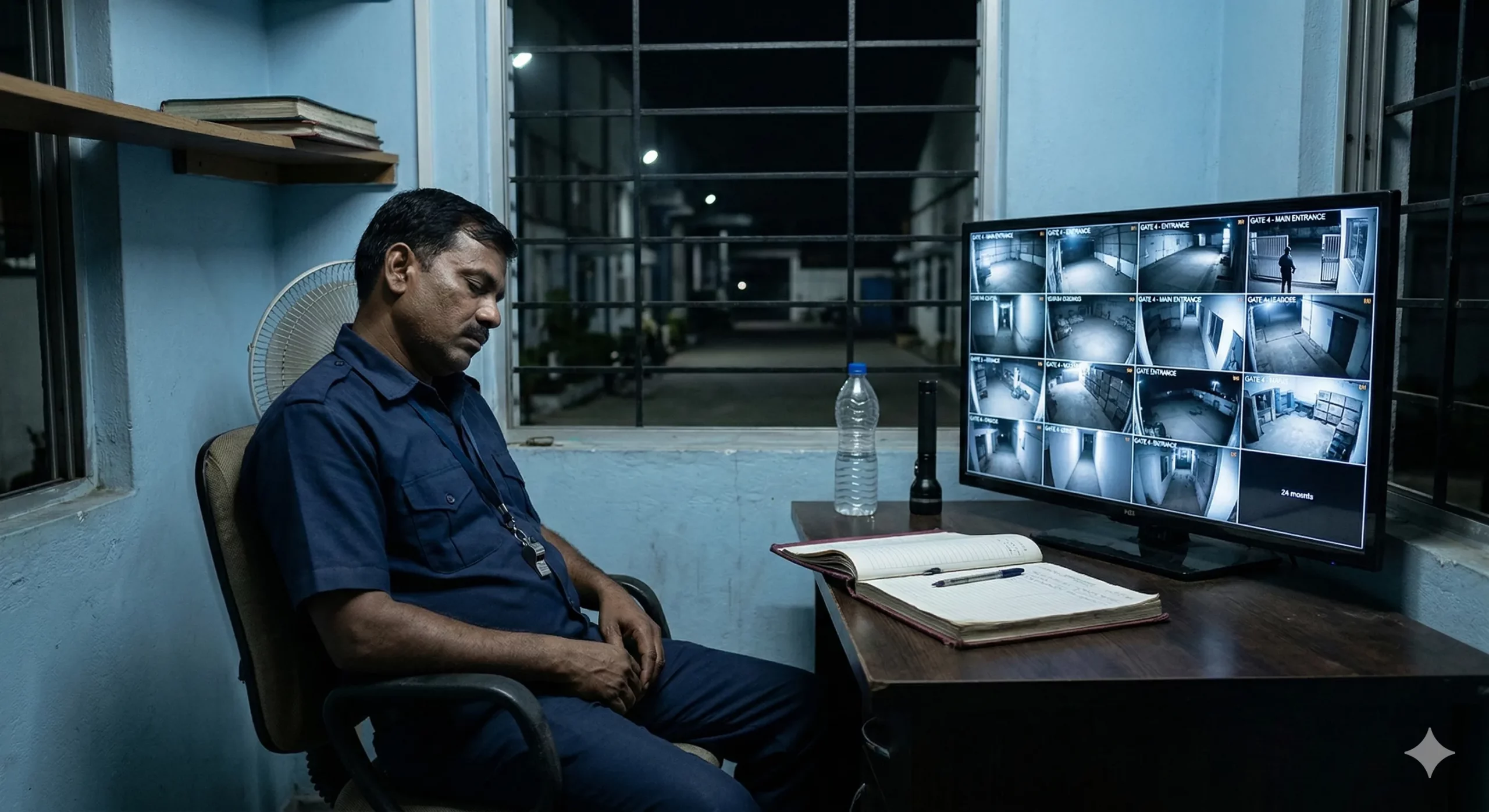
The typical setup looks like this: a DVR or NVR connected to 8, 16, or 32 cameras. A monitor showing a grid of tiny thumbnails. A security guard assigned to sit in front of it during his shift. Sometimes there is a logbook where he notes down anything unusual. Sometimes there is not even that.
Business owners assume this is CCTV monitoring. After all, there is a person watching the cameras. But there is a massive gap between a guard glancing at screens and a trained operator actively monitoring feeds with technology-assisted alerts. Understanding this gap is the difference between having security that works and having security that only looks like it works.
Problem 1: The Human Attention Limit
Research consistently shows that a person watching multiple CCTV screens experiences significant attention decline after just 20 minutes. After 40 minutes, the ability to detect unusual activity drops drastically. This is not about laziness or incompetence. It is basic human biology. Our brains are not designed to maintain focused attention on static video feeds for hours.
The attention problem in numbers:
A guard watching 16 camera feeds on one screen sees each feed in a thumbnail roughly the size of a playing card. Studies on CCTV operator performance show that after 20 minutes of continuous monitoring, detection rates for unusual events drop significantly. By the 1-hour mark, an operator may miss the majority of events. Now consider that your guard is doing this for an 8 to 12 hour shift, often alone, often at night.
Professional monitoring centres solve this with shift rotations, technology-assisted alerts, and operators who are trained specifically for video surveillance. Your guard was hired to stand at a gate, not to perform sustained visual surveillance across dozens of camera feeds.
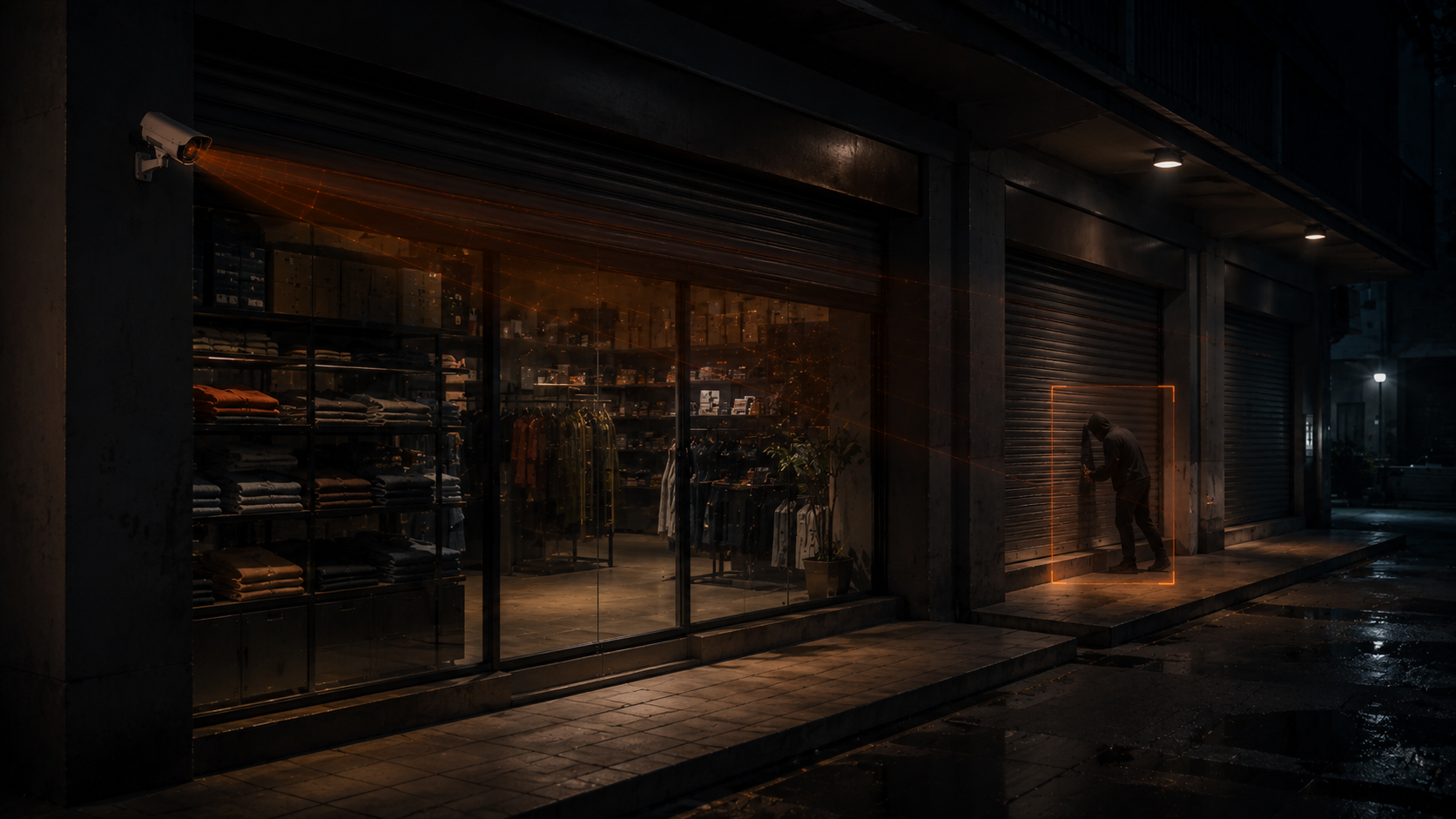
At Modernext, our operators do not stare at 16 thumbnails hoping to catch something. A stray cat at your back wall at 2 AM does not waste anyone’s time. A person approaching your loading dock at 2 AM gets immediate attention. The operator makes a decision and acts within seconds. That is the difference between watching and monitoring.
Problem 2: No Training for Video Surveillance
Security guards in India are typically trained for access control, patrolling, and basic emergency response. They are not trained to interpret camera feeds, identify pre-incident behaviour patterns, distinguish between genuine threats and false alarms, or respond to visual alerts with a structured escalation protocol.
Professional CCTV monitoring operators undergo dedicated training that includes:
- Threat identification — recognising suspicious behaviour before an incident occurs
- Camera operation — knowing when to zoom, pan, or switch to a specific feed
- Escalation protocols — exactly what to do when a threat is verified, in what order
- False alarm management — quickly filtering out animals, shadows, weather triggers
- Evidence documentation — capturing and saving footage that holds up legally
- Multi-site awareness — monitoring patterns across different locations simultaneously
Asking an untrained guard to perform video surveillance is like asking a receptionist to manage your IT network because the computer is on their desk. The equipment is there, but the expertise is not.
When a Modernext operator sees someone lingering near your back gate at 1 AM, they do not just flag it. They assess the behaviour, determine the threat level, and act. If it is a genuine threat, a live voice warning goes out within seconds. If it is a delivery driver waiting early, it gets logged and dismissed. Your guard would see the same thumbnail and either miss it entirely or not know what to do with it.
Problem 3: Your Guard Has Other Duties
In most businesses, the guard watching CCTV screens is also responsible for other tasks. He opens the gate for vehicles. He checks visitor IDs. He does rounds of the premises. He handles deliveries. He answers the intercom. He takes phone calls from the owner or manager.
Every time he leaves the screen to perform any of these tasks, your cameras are unmonitored. And these interruptions do not happen occasionally. They happen constantly throughout the shift. In a typical night shift, the guard may spend more time away from the screen than in front of it.
A typical guard’s night shift:
11:00 PM — Starts shift, sits in front of screens
11:20 PM — Opens gate for late employee
11:45 PM — Does first round of premises
12:30 AM — Back at screens, starting to feel drowsy
1:15 AM — Checks on locked doors
2:00 AM — Peak fatigue zone. Struggling to stay awake
3:30 AM — Dozing in chair. Screens running unwatched
5:00 AM — Wakes up, checks screens. Nothing looks different
Total effective screen time: Maybe 2 to 3 hours out of an 8-hour shift
A professional monitoring centre operator has one job: watch camera feeds. No gates to open. No visitors to manage. No rounds to do. Just focused, continuous surveillance with real-time alerts highlighting what needs attention.
When we monitor a site at Modernext, the coverage does not depend on one person’s availability. At 11:20 PM when your guard walks out to open the gate, our operator sees every camera. At midnight when he does his round, we are on every feed. At 3 AM when he is dozing off in his chair — and this happens at every site, every night — our operator spots an intruder at your rear wall and issues a voice warning before your guard even wakes up.
Problem 4: No Response Capability from the Guard Room
Suppose your guard actually spots something on the screen. An intruder climbing the back wall at 2 AM. What does he do? He is one person, alone, in a guard room. He cannot confront the intruder and watch the screens simultaneously. He may not have a way to immediately contact you or the police. He has no two-way audio to warn the intruder. He may freeze, or worse, feel unsafe confronting the situation alone.
Professional monitoring changes this completely:
Step 1: Motion detected at the back wall. Alert sent to operator instantly
Step 2: Operator verifies on live feed — confirms intruder, not a stray animal
Step 3: Live voice warning issued through two-way audio: “You are being recorded. Authorities have been notified. Leave immediately.”
Step 4: Simultaneously: owner alerted instantly via call and app notification, on-site guard directed to the exact location, local authorities notified if needed
Step 5: Full incident documented with timestamped video evidence
All of this happens within 60 seconds of detection
The guard is still useful in this scenario. But instead of being the eyes AND the hands AND the brain, he only needs to be the hands — directed to the right spot by the monitoring team who are the eyes and the brain.
Here is what this looks like in practice with Modernext. The last step in the process is not “alert sent to owner.” When our operator confirms an intruder, a voice warning goes out immediately through the camera speaker. Your guard gets a call telling him exactly where to go. You get an instant notification on your phone. If the situation escalates, we coordinate with local police. Nobody is left guessing what to do next.
Problem 5: Zero Accountability and No Records
When your guard is watching the screens, there is no record of what he actually saw, when he saw it, or what he did about it. Did he notice the person loitering near the loading dock at midnight? You will never know. Was he actually watching the screen at 3 AM when the pilferage happened? There is no way to verify.
Professional monitoring provides complete accountability:
- Every alert logged with timestamp, camera ID, and operator action taken
- Incident reports with video clips delivered to your phone or email
- Operator activity tracking — the monitoring centre knows exactly which feeds were being watched at any given time
- Shift handover documentation — nothing falls through the cracks between shifts
- Monthly reports showing alert patterns, response times, and security trends
This accountability is not just about catching problems. It is invaluable for insurance claims, police complaints, employee disputes, and management decisions about where to strengthen security.
Here is what your morning looks like with Modernext monitoring. You open the app and see a clear timeline of the night. “2:47 AM — Motion detected at rear wall, Camera 12. Operator verified: stray dog. No action required.” Next entry: “4:15 AM — Person approached main gate, Camera 3. Operator issued voice warning. Person left immediately. Video clip attached.” You know exactly what happened, when, and what was done about it. Compare that to asking your guard in the morning and hearing “sab theek tha, sahab.”
Problem 6: Guard Compromise and Insider Risk
This is the problem nobody talks about openly, but every business owner knows it exists. Your guard is a local hire. He knows your staff. He knows their routines. In cases of employee pilferage or organised theft, the guard watching the CCTV may be the first person approached to look the other way.
Even without deliberate compromise, there are subtle risks. A friendly guard may not report a colleague entering a restricted area. He may delete or fail to flag footage that shows someone he knows. He may be pressured or threatened into silence.
Remote monitoring operators have zero personal connection to your staff. They are in a different city, watching feeds from dozens of businesses. They have no reason and no incentive to look the other way. They cannot be bribed, befriended, or intimidated by anyone on your premises.
Our operators at Modernext are in a completely different city. They do not know your warehouse manager’s name. They do not know which employee is the owner’s nephew. When they see someone loading goods into an unauthorized vehicle at 3 AM, they flag it, record it, and alert you with video evidence. There is no relationship to protect, no pressure to stay quiet, no reason to look the other way. That is a level of objectivity you simply cannot get from someone who sits in your guard room every day.
Side-by-Side: Guard Room vs Professional Monitoring
| Factor | Guard Watching Screens | Professional Monitoring |
|---|---|---|
| Effective watch time | 2-3 hours per 8-hour shift | Continuous, 100% of shift |
| Alert detection | Human eyes scanning tiny thumbnails | Smart detection + trained operator |
| Response time | Minutes (if he notices at all) | Under 60 seconds |
| Two-way audio | Not available | Live voice warnings to intruders |
| Incident documentation | Verbal report, maybe a logbook entry | Timestamped video + written report |
| Accountability | No way to verify what was watched | Full operator activity logs |
| Insider risk | Can be compromised by staff | Zero connection to your employees |
| Fatigue at 3 AM | Severe — likely asleep or dozing | Fresh operator on rotation |
| Multi-site capability | One guard per site | All sites from one centre |
The Right Approach: Keep Your Guard, Add Professional Monitoring
This is not about firing your security guard. A guard on-site provides physical presence, handles access control, manages visitors, and can physically respond when directed. These are valuable functions that remote monitoring cannot replace.
The smartest approach is a hybrid model:
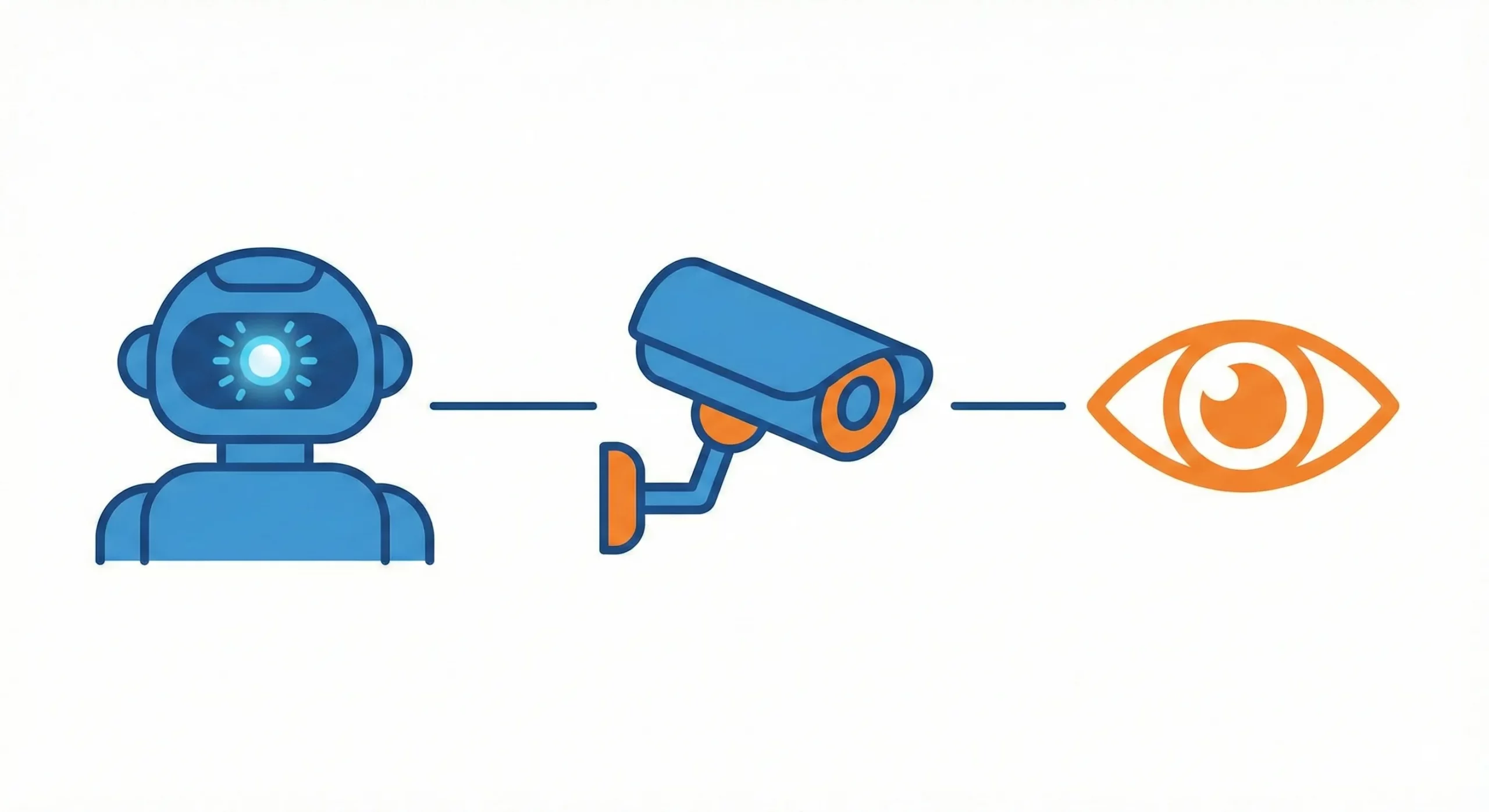
- Professional monitoring centre watches all camera feeds continuously — they are the eyes
- Your on-site guard handles physical duties — he is the hands
- When an alert triggers, the monitoring centre verifies and directs the guard to the exact location
- The guard no longer needs to watch screens — he can focus on patrols, access control, and physical presence
- Both are more effective because each is doing what they are trained for
Your guard becomes significantly more effective when he is not burdened with a task he was never trained for. And your cameras finally have someone watching them who actually knows what to look for.
How to Get Started
Switching to professional monitoring does not require replacing your cameras, your DVR, or your guard. Modernext works with your existing CCTV system. We install one small device near your NVR — it just needs an ethernet port and a power supply. No new wiring. No camera changes. Your existing setup starts being professionally monitored from day one.
Step 1: We assess your current camera setup and site requirements
Step 2: We install one Modernext device near your NVR and configure it
Step 3: Your camera feeds are securely connected to our monitoring centre
Step 4: Trained operators begin watching your feeds during your chosen hours
Step 5: Your guard gets freed up to do his actual job — physical security
Your Guard Can’t Watch 16 Screens for 8 Hours. We Can.
Tell us how many cameras you have. We will show you what professional monitoring looks like for your setup.
Frequently Asked Questions
Will professional monitoring replace my security guard?
No. Professional monitoring replaces the screen-watching part of your guard’s job. Your guard continues handling physical security — access control, patrols, visitor management, and on-ground response. In fact, your guard becomes more effective because he is directed by the monitoring team to exactly where he is needed.
Do I need to change my existing cameras or DVR?
No. Modernext works with your existing cameras and DVR/NVR. We install one small device near your NVR that connects your system to our monitoring centre. It just needs an ethernet port and a power supply — no new wiring, no camera changes.
What if my internet goes down?
Our system immediately detects when a site goes offline and alerts both the operator and you. Backup options like 4G failover can be set up for critical sites. Your local DVR continues recording even if the internet is down, so no footage is lost.
Is it more expensive than paying my guard to watch screens?
You are already paying the guard. Professional monitoring is an additional cost, but it is a fraction of what you would pay for a dedicated, trained CCTV operator. More importantly, it actually works — preventing even one incident typically pays for months of monitoring. Read our complete pricing guide for detailed cost breakdowns.
Can I choose which hours to monitor?
Yes. Most businesses start with after-hours monitoring — typically 7 PM to 9 AM — when the premises are closed and most vulnerable. You can choose the hours that match your risk profile.
Related Articles
→ 5 Signs Your Business Needs Professional CCTV Monitoring
→ CCTV Monitoring Cost in India 2026: Complete Pricing Guide
→ CCTV Monitoring vs Security Guard: Which Is Better?
→ Remote CCTV Monitoring Services in India
→ Cybersecurity for CCTV: Protecting Your Cameras from Hackers
Free Assessment: Is Your Guard Room Setup Actually Working?
Send us your camera count, DVR model, and current setup. We will tell you exactly what professional monitoring would look like for your business.